• Copy Image
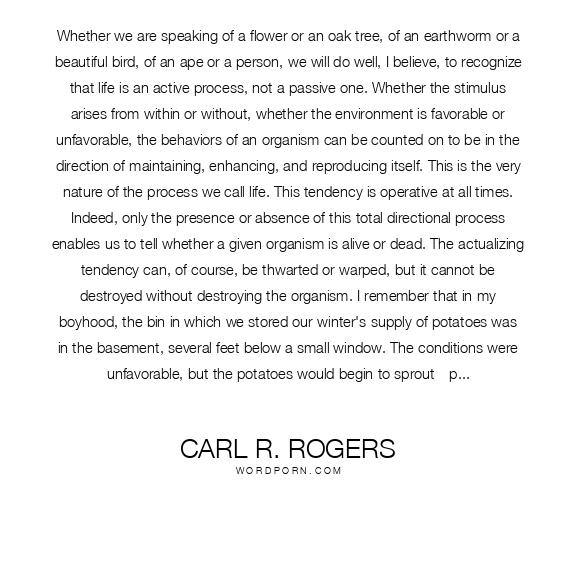
    Carl R. Rogers quote. Whether we are speaking of a flower or an oak tree, of an earthworm or a beautiful bird, of an ape or a person, we will do well, I believe, to recognize that life is an active process, not a passive one. Whether the stimulus arises from within or without, whether the environment is favorable or unfavorable, the behaviors of an organism can be counted on to be in the direction of maintaining, enhancing, and reproducing itself. This is the very nature of the process we call life. This tendency is operative at all times. Indeed, only the presence or absence of this total directional process enables us to tell whether a given organism is alive or dead. The actualizing tendency can, of course, be thwarted or warped, but it cannot be destroyed without destroying the organism. I remember that in my boyhood, the bin in which we stored our winter's supply of potatoes was in the basement, several feet below a small window. The conditions were unfavorable, but the potatoes would begin to sprout—pale white sprouts, so unlike the healthy green shoots they sent up when planted in the soil in the spring. But these sad, spindly sprouts would grow 2 or 3 feet in length as they reached toward the distant light of the window. The sprouts were, in their bizarre, futile growth, a sort of desperate expression of the directional tendency I have been describing. They would never become plants, never mature, never fulfill their real potential. But under the most adverse circumstances, they were striving to become. Life would not give up, even if it could not flourish. In dealing with clients whose lives have been terribly warped, in working with men and women on the back wards of state hospitals, I often think of those potato sprouts. So unfavorable have been the conditions in which these people have developed that their lives often seem abnormal, twisted, scarcely human. Yet, the directional tendency in them can be trusted. The clue to understanding their behavior is that they are striving, in the only ways that they perceive as available to them, to move toward growth, toward becoming. To healthy persons, the results may seem bizarre and futile, but they are life's desperate attempt to become itself. This potent constructive tendency is an underlying basis of the person-centered approach

    Whether we are speaking of a flower or an oak tree, of an earthworm or a beautiful bird, of an ape or a person, we will do well, I believe, to recognize that life is an active process, not a passive one. Whether the stimulus arises from within or without, whether the environment is favorable or unfavorable, the behaviors of an organism can be counted on to be in the direction of maintaining, enhancing, and reproducing itself. This is the very nature of the process we call life. This tendency is operative at all times. Indeed, only the presence or absence of this total directional process enables us to tell whether a given organism is alive or dead. The actualizing tendency can, of course, be thwarted or warped, but it cannot be destroyed without destroying the organism. I remember that in my boyhood, the bin in which we stored our winter's supply of potatoes was in the basement, several feet below a small window. The conditions were unfavorable, but the potatoes would begin to sprout—pale white sprouts, so unlike the healthy green shoots they sent up when planted in the soil in the spring. But these sad, spindly sprouts would grow 2 or 3 feet in length as they reached toward the distant light of the window. The sprouts were, in their bizarre, futile growth, a sort of desperate expression of the directional tendency I have been describing. They would never become plants, never mature, never fulfill their real potential. But under the most adverse circumstances, they were striving to become. Life would not give up, even if it could not flourish. In dealing with clients whose lives have been terribly warped, in working with men and women on the back wards of state hospitals, I often think of those potato sprouts. So unfavorable have been the conditions in which these people have developed that their lives often seem abnormal, twisted, scarcely human. Yet, the directional tendency in them can be trusted. The clue to understanding their behavior is that they are striving, in the only ways that they perceive as available to them, to move toward growth, toward becoming. To healthy persons, the results may seem bizarre and futile, but they are life's desperate attempt to become itself. This potent constructive tendency is an underlying basis of the person-centered approach

    Carl R. Rogers
    Moms Typewriter
    A
    A
  • Copy Image
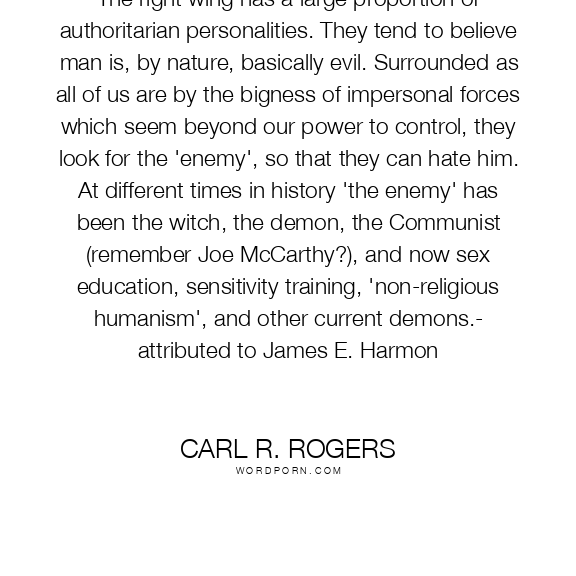
    Carl R. Rogers quote. The right wing has a large proportion of authoritarian personalities. They tend to believe man is, by nature, basically evil. Surrounded as all of us are by the bigness of impersonal forces which seem beyond our power to control, they look for the 'enemy', so that they can hate him. At different times in history 'the enemy' has been the witch, the demon, the Communist (remember Joe McCarthy?), and now sex education, sensitivity training, 'non-religious humanism', and other current demons.- attributed to James E. Harmon

    The right wing has a large proportion of authoritarian personalities. They tend to believe man is, by nature, basically evil. Surrounded as all of us are by the bigness of impersonal forces which seem beyond our power to control, they look for the 'enemy', so that they can hate him. At different times in history 'the enemy' has been the witch, the demon, the Communist (remember Joe McCarthy?), and now sex education, sensitivity training, 'non-religious humanism', and other current demons.- attributed to James E. Harmon

    Carl R. Rogers
    Moms Typewriter
    A
    A
  • Copy Image
    Carl R. Rogers quote. I am isolated. I sit in a glass ball, I see people through a glass wall. I scream, but they do not hear me.- Ellen West

    I am isolated. I sit in a glass ball, I see people through a glass wall. I scream, but they do not hear me.- Ellen West

    Carl R. Rogers
    Moms Typewriter
    A
    A
  • Copy Image
    Carl R. Rogers quote. When the locus of evaluation is seen as residing in the expert, it would appear that the long-range social implications are in the direction of the social control of the many by the few

    When the locus of evaluation is seen as residing in the expert, it would appear that the long-range social implications are in the direction of the social control of the many by the few

    Carl R. Rogers
    Moms Typewriter
    A
    A
  • Copy Image
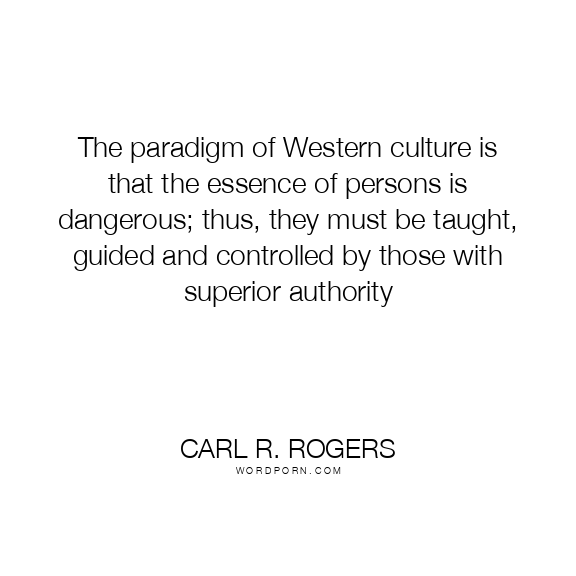
    Carl R. Rogers quote. The paradigm of Western culture is that the essence of persons is dangerous; thus, they must be taught, guided and controlled by those with superior authority
    The paradigm of Western culture is that the essence of persons is dangerous; thus, they must be taught, guided and controlled by those with superior authority
    Carl R. Rogers
    Moms Typewriter
    A
    A
loader
Post as Image: