• Copy Image
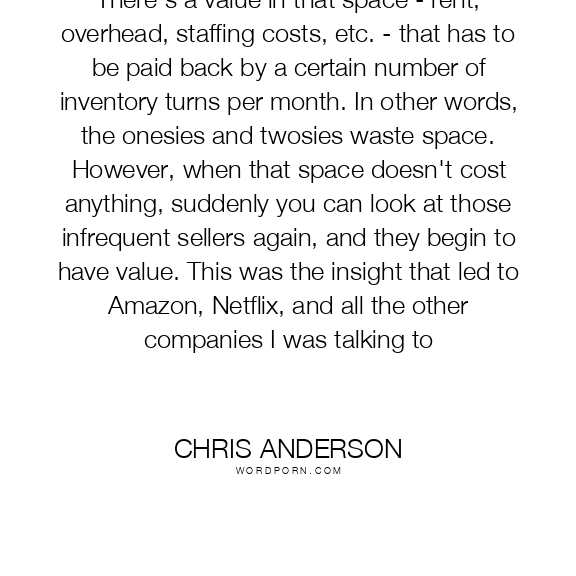
    Chris Anderson quote. What we're now starting to see, as online retailers begin to capitalize on their extraordinary economic efficiences, is the shape of a massive mountain of choice emerging where before there was just a peak.... By necessity, the conomics of traditional, hit-driven retail limit choice. When you dramatically lower the costs of connecting supply and demand, it changes not just the numbers, but the entire nature of the market. This is not just a quantiative change, but a qualitative one, too. Bringing niches within reach reveals latent demand for noncommercial content. Then, as demand shifts toward the niches, the economics of provided them improve further, and so on, creating a positive feedback loop that will transform entire industries - and the culture - for decades to come

    What we're now starting to see, as online retailers begin to capitalize on their extraordinary economic efficiences, is the shape of a massive mountain of choice emerging where before there was just a peak.... By necessity, the conomics of traditional, hit-driven retail limit choice. When you dramatically lower the costs of connecting supply and demand, it changes not just the numbers, but the entire nature of the market. This is not just a quantiative change, but a qualitative one, too. Bringing niches within reach reveals latent demand for noncommercial content. Then, as demand shifts toward the niches, the economics of provided them improve further, and so on, creating a positive feedback loop that will transform entire industries - and the culture - for decades to come

    Chris Anderson
    Moms Typewriter
    A
    A
  • Copy Image
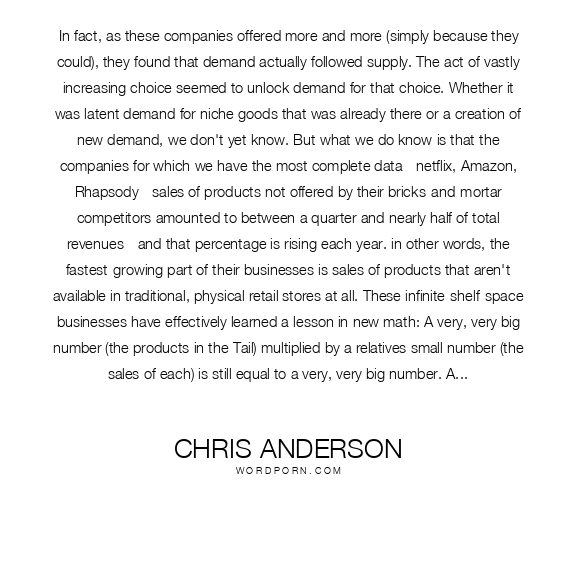
    Chris Anderson quote. What people intuitively grasped was the new efficiences in distribution, manufacturing, and marketing were changing the definition of what was commercially viable across the board. The best way to describe these forces is that they are turning unprofitable customers, products, and markets into profitable ones. Although this phenomenon is most obvious in entertainment and media, it's an easy leap to eBay to see it at work more broadly, from cars to crafts. Seen broadly, it's clear that the story of the Long Tail is really about the economics of abundance - what happens when the bottlenecks and stand between supply and demand in our culture start to disappear and everything becomes available to everyone

    What people intuitively grasped was the new efficiences in distribution, manufacturing, and marketing were changing the definition of what was commercially viable across the board. The best way to describe these forces is that they are turning unprofitable customers, products, and markets into profitable ones. Although this phenomenon is most obvious in entertainment and media, it's an easy leap to eBay to see it at work more broadly, from cars to crafts. Seen broadly, it's clear that the story of the Long Tail is really about the economics of abundance - what happens when the bottlenecks and stand between supply and demand in our culture start to disappear and everything becomes available to everyone

    Chris Anderson
    Moms Typewriter
    A
    A
  • Copy Image
    Chris Anderson quote. The three main observactions - (1) the tail of available variety is far longer than we realize; (2) it's now within reach economically; (3) all those niches, when aggregated, can make up a significant market - seemed indisputable, especially baked up with heretofore unseen data

    The three main observactions - (1) the tail of available variety is far longer than we realize; (2) it's now within reach economically; (3) all those niches, when aggregated, can make up a significant market - seemed indisputable, especially baked up with heretofore unseen data

    Chris Anderson
    Moms Typewriter
    A
    A
  • Copy Image
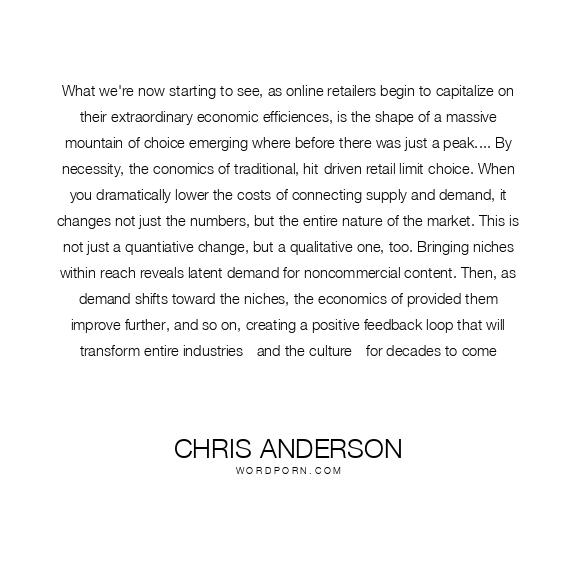
    Chris Anderson quote. There's a value in that space - rent, overhead, staffing costs, etc. - that has to be paid back by a certain number of inventory turns per month. In other words, the onesies and twosies waste space. However, when that space doesn't cost anything, suddenly you can look at those infrequent sellers again, and they begin to have value. This was the insight that led to Amazon, Netflix, and all the other companies I was talking to

    There's a value in that space - rent, overhead, staffing costs, etc. - that has to be paid back by a certain number of inventory turns per month. In other words, the onesies and twosies waste space. However, when that space doesn't cost anything, suddenly you can look at those infrequent sellers again, and they begin to have value. This was the insight that led to Amazon, Netflix, and all the other companies I was talking to

    Chris Anderson
    Moms Typewriter
    A
    A
  • Copy Image
    Chris Anderson quote. In fact, as these companies offered more and more (simply because they could), they found that demand actually followed supply. The act of vastly increasing choice seemed to unlock demand for that choice. Whether it was latent demand for niche goods that was already there or a creation of new demand, we don't yet know. But what we do know is that the companies for which we have the most complete data - netflix, Amazon, Rhapsody - sales of products not offered by their bricks-and-mortar competitors amounted to between a quarter and nearly half of total revenues - and that percentage is rising each year. in other words, the fastest-growing part of their businesses is sales of products that aren't available in traditional, physical retail stores at all. These infinite-shelf-space businesses have effectively learned a lesson in new math: A very, very big number (the products in the Tail) multiplied by a relatives small number (the sales of each) is still equal to a very, very big number. And, again, that very, very big number is only getting bigger. What's more, these millions of fringe sales are an efficient, cost-effective business. With no shelf space to pay for - and in the case of purely digital services like iTunes, no manufacturing costs and hardly any distribution fees - a niche product sold is just another sale, with the same (or better) margins as a hit. For the first time in history, hits and niches are on equal economic footing, both just entries in a database called up on demand, both equally worthy of being carried. Suddenly, popularity no longer has a monopoly on profitability
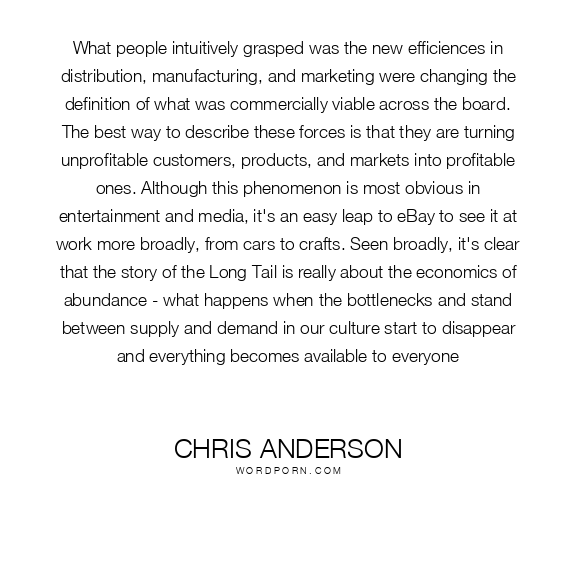
    In fact, as these companies offered more and more (simply because they could), they found that demand actually followed supply. The act of vastly increasing choice seemed to unlock demand for that choice. Whether it was latent demand for niche goods that was already there or a creation of new demand, we don't yet know. But what we do know is that the companies for which we have the most complete data - netflix, Amazon, Rhapsody - sales of products not offered by their bricks-and-mortar competitors amounted to between a quarter and nearly half of total revenues - and that percentage is rising each year. in other words, the fastest-growing part of their businesses is sales of products that aren't available in traditional, physical retail stores at all. These infinite-shelf-space businesses have effectively learned a lesson in new math: A very, very big number (the products in the Tail) multiplied by a relatives small number (the sales of each) is still equal to a very, very big number. And, again, that very, very big number is only getting bigger. What's more, these millions of fringe sales are an efficient, cost-effective business. With no shelf space to pay for - and in the case of purely digital services like iTunes, no manufacturing costs and hardly any distribution fees - a niche product sold is just another sale, with the same (or better) margins as a hit. For the first time in history, hits and niches are on equal economic footing, both just entries in a database called up on demand, both equally worthy of being carried. Suddenly, popularity no longer has a monopoly on profitability
    Chris Anderson
    Moms Typewriter
    A
    A
loader
Post as Image: