
Copy Image
To walk is to lack a place. It is the indefinite process of being absent and in search of a proper. The moving about that the city mutliplies and concentrates makes the city itself an immense social experience of lacking a place -- an experience that is, to be sure, broken up into countless tiny deportations (displacements and walks), compensated for by the relationships and intersections of these exoduses that intertwine and create an urban fabric, and placed under the sign of what ought to be, ultimately, the place but is only a name, the City...a universe of rented spaces haunted by a nowhere or by dreamed-of places
Michel de Certeau
-
-
Copy Image
To practice space is thus to repeat the joyful and silent experience of childhood; it is, in a place, to be other and to move toward the other...Kandinsky dreamed of: 'a great city built according to all the rules of architecture and then suddenly shaken by a force that defies all calculation
-
Copy Image
The same is true of stories and legends that haunt urban space like superfluous or additional inhabitants. They are the object of a witch-hunt, by the very logic of the techno-structure. But [the extermination of proper place names] (like the extermination of trees, forests, and hidden places in which such legends live) makes the city a 'suspended symbolic order.' The habitable city is thereby annulled. Thus, as a woman from Rouen put it, no, here 'there isn't any place special, except for my own home, that's all...There isn't anything.' Nothing 'special': nothing that is marked, opened up by a memory or a story, signed by something or someone else. Only the cave of the home remains believable, still open for a certain time to legends, still full of shadows. Except for that, according to another city-dweller, there are only 'places in which one can no longer believe in anything
-
Copy Image
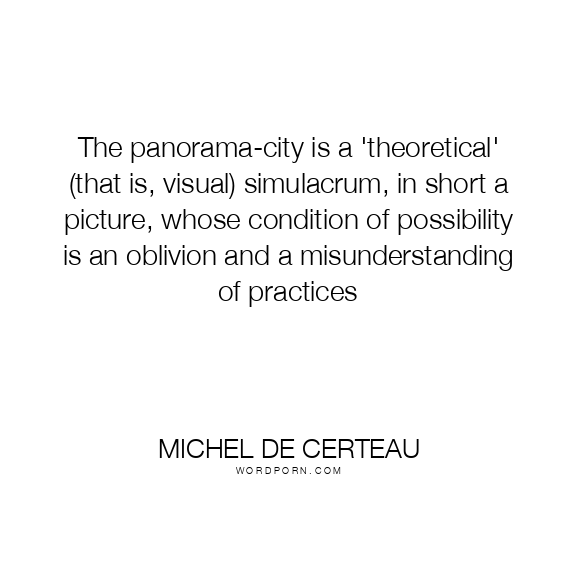
The panorama-city is a 'theoretical' (that is, visual) simulacrum, in short a picture, whose condition of possibility is an oblivion and a misunderstanding of practices
-
Copy Image
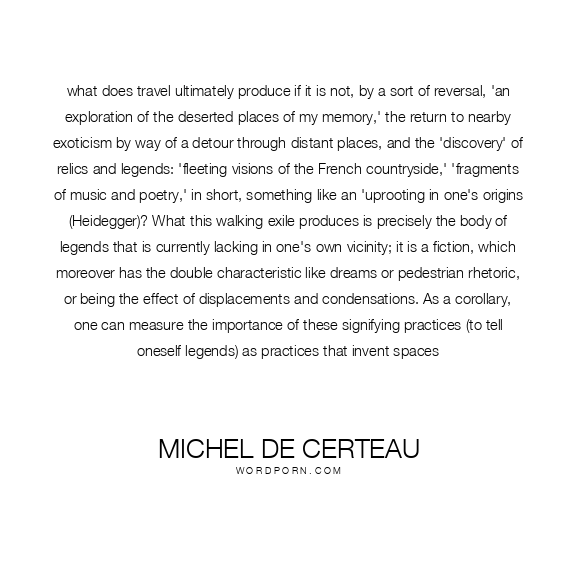
what does travel ultimately produce if it is not, by a sort of reversal, 'an exploration of the deserted places of my memory,' the return to nearby exoticism by way of a detour through distant places, and the 'discovery' of relics and legends: 'fleeting visions of the French countryside,' 'fragments of music and poetry,' in short, something like an 'uprooting in one's origins (Heidegger)? What this walking exile produces is precisely the body of legends that is currently lacking in one's own vicinity; it is a fiction, which moreover has the double characteristic like dreams or pedestrian rhetoric, or being the effect of displacements and condensations. As a corollary, one can measure the importance of these signifying practices (to tell oneself legends) as practices that invent spaces

Post as Image: