• Copy Image
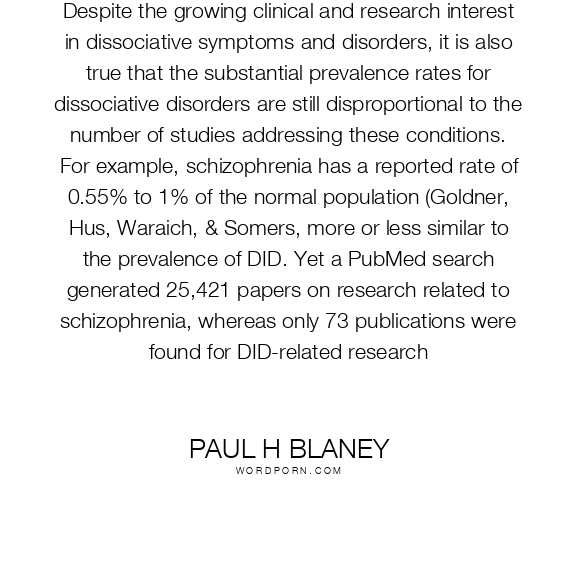
    Paul H Blaney quote. Despite the growing clinical and research interest in dissociative symptoms and disorders, it is also true that the substantial prevalence rates for dissociative disorders are still disproportional to the number of studies addressing these conditions. For example, schizophrenia has a reported rate of 0.55% to 1% of the normal population (Goldner, Hus, Waraich, & Somers, more or less similar to the prevalence of DID. Yet a PubMed search generated 25,421 papers on research related to schizophrenia, whereas only 73 publications were found for DID-related research

    Despite the growing clinical and research interest in dissociative symptoms and disorders, it is also true that the substantial prevalence rates for dissociative disorders are still disproportional to the number of studies addressing these conditions. For example, schizophrenia has a reported rate of 0.55% to 1% of the normal population (Goldner, Hus, Waraich, & Somers, more or less similar to the prevalence of DID. Yet a PubMed search generated 25,421 papers on research related to schizophrenia, whereas only 73 publications were found for DID-related research

    Paul H Blaney
    Moms Typewriter
    A
    A
  • Copy Image
    Paul H Blaney quote. The lifetime prevalence of dissociative disorders among women in a general urban Turkish community was 18.3%, with 1.1% having DID (ar, Akyüz, & Doan, 2007). In a study of an Ethiopian rural community, the prevalence of dissociative rural community, the prevalence of dissociative disorders was 6.3%, and these disorders were as prevalent as mood disorders (6.2%), somatoform disorders (5.9%), and anxiety disorders (5.7%) (Awas, Kebede, & Alem, 1999). A similar prevalence of ICD-10 dissociative disorders (7.3%) was reported for a sample of psychiatric patients from Saudi Arabia (AbuMadini & Rahim, 2002)
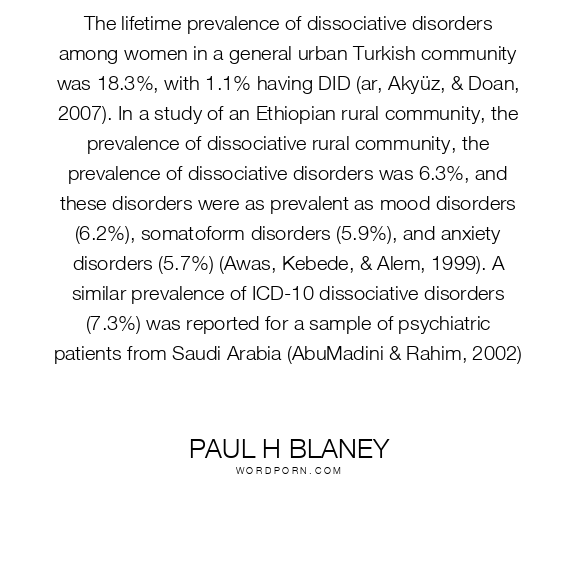
    The lifetime prevalence of dissociative disorders among women in a general urban Turkish community was 18.3%, with 1.1% having DID (ar, Akyüz, & Doan, 2007). In a study of an Ethiopian rural community, the prevalence of dissociative rural community, the prevalence of dissociative disorders was 6.3%, and these disorders were as prevalent as mood disorders (6.2%), somatoform disorders (5.9%), and anxiety disorders (5.7%) (Awas, Kebede, & Alem, 1999). A similar prevalence of ICD-10 dissociative disorders (7.3%) was reported for a sample of psychiatric patients from Saudi Arabia (AbuMadini & Rahim, 2002)

    Paul H Blaney
    Moms Typewriter
    A
    A
loader
Post as Image: